

Collecting premiums
like an insurance company
Regular income like an insurance company:
Earn with put options regardless of
market fluctuations.
Options trading – here’s how it works!
Insurance companies protect their clients’ assets and collect premiums year after year for it. Even when claims occur, there is still a profit left over – after all, the insurance company calculates its risks more than accurately. How nice would it be if investors could also generate regular income on their own capital, independent of the ups and downs in the markets? The good news: We can all start a “one-man insurance company.” The following article shows how it works and why selling put options is an excellent income strategy.
The insurance business as a model
An insurance company makes its money by taking on different risks from policyholders in exchange for regular premium payments. A concrete example is insuring a building against fire and natural disasters like lightning and hail. In practice, a business year for the company could be simplified as follows:
The insurance has insured 10,000 buildings (total value approx. €500 million)
Per building on average €1000 annual premium
Total: €10 million premium income (4% of the insured building value)
The income side is of course only one side of the business, after all, the insurance company has to dig deep into its pockets from time to time – for example, when a flood disaster occurs. If we assume that in any given insurance year €3 million in claims arise, this example (without considering other costs such as personnel, etc.) results in a profit of €7 million.
Of course, an insurance company must know its risks very well in order to set the correct premium level and generate profits in the long term. If the insurance company calculates with premiums that are too low, its existence may be at stake if the claims payments are too high. In this specific case, the company must know the potential risk of natural disasters (their probability and financial impact) in the respective region. It must also check in advance the condition of the insured objects. Are they residential or commercial properties? What is the condition of the water pipes, the entire electrical system, etc.?
Risks that the insurance company does not want to take on its books even for high premium payments are either not insured at all or are transferred – again for a premium payment – to other insurance companies (so-called reinsurers). While part of the premium income goes towards risk transfer, the insurance company reduces its overall risk. In the end, premiums must be higher than claims payments in the long run; otherwise, the insurance company is not viable*.

*While there is another main source of profit in the insurance business – namely the income generated from investing the premiums – this will not be considered here for simplification purposes.
Transferring the business model to the stock market
How can we as private investors transfer this business model to stock trading? We cannot and should not start an insurance company, but we can earn money in the same way by selling so-called put options and collecting premiums.
Before we dive into the details, let’s first briefly explain what an option is: Options are standardized and exchange-traded derivatives that document certain rights and obligations for both the buyer and the seller. Such options are primarily traded on options exchanges in the USA or at Eurex in Germany.
To stay with our insurance comparison, we will focus solely on so-called put options in this article. The buyer of a put option has the right to sell the underlying asset (e.g., a stock) to the put seller at a predefined price within a certain time frame**.
**We focus here on American-style options. Here, the option buyer can theoretically exercise the option at any time before expiration, but in practice, this usually only happens when the option is deep in the money and the expiration date is approaching.
| Options exercise | When can it be exercised? |
| American style | during the term |
| European style | only at the end of the term |
Instead of insuring buildings or cars against damage, put sellers offer other market participants (the put buyers), who want to hedge their stocks against a price decline, a kind of insurance and collect a premium for taking on the risk. Let’s look at the following example:
Investor A has 100 XYZ shares in his portfolio, which are trading at $100. He wants to hedge against a price drop below $90, which in the insurance world would correspond to a deductible of 10% of the insured value. Or simplified: Investor A bears the first 10% price loss of the stock alone; he wants to hedge everything below that.
He can do exactly that by purchasing a put with a so-called strike at $90.
For this, he pays, for a certain term of the option (corresponding to the insurance duration), for example, $2 per share, totaling $200. This $200 per share is received by the seller of the put option as a premium and can keep it regardless of the outcome. Since there is a risk of having to acquire the XYZ stock (this is referred to as the so-called delivery), the put seller must have the necessary capital of $10,000 available in his brokerage account – similar to the insurance company, which holds capital to be able to pay out in case of damages***.
***Here we focus on trading without margin, hence the term “cash secured puts.”
From the moment the put is sold, time runs for the writer, as the time value of the option decreases day by day. If the stock remains above the strike until expiration, the put option expires worthless, and the writer can use the capital that has been tied up until then for a new put sale. For example, he could sell a put on stocks about 12 times a year, each with a term of around 30 days, and collect a premium each time.
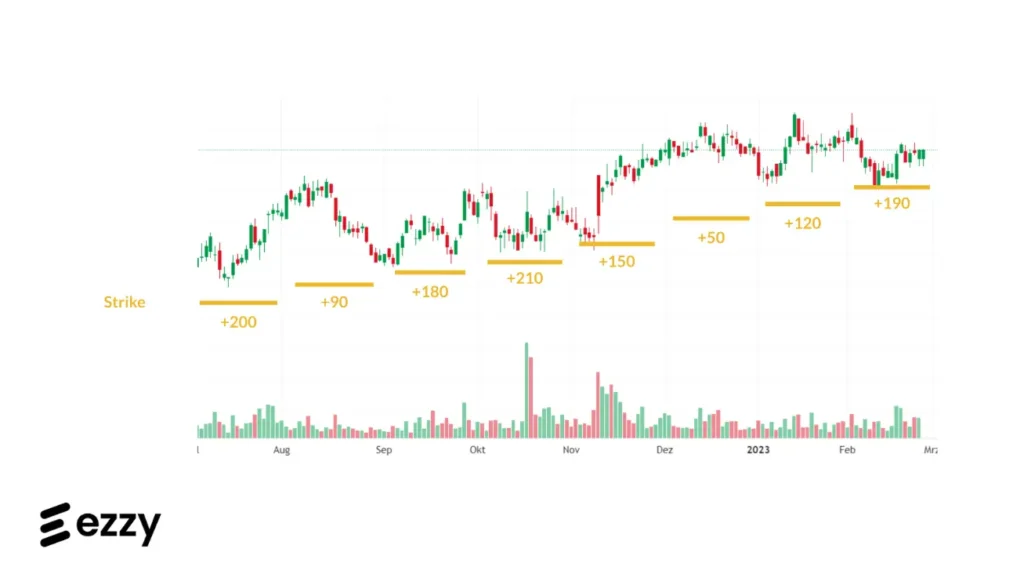
The goal of the put seller is, of course, that the “claim,” i.e., the price drop of the stock below the strike of $90 does not occur by the end of the term – just like the insurance company hopes that most buildings do not fall victim to fire, flood, or other damages. As long as the stock is trading above the strike or even rising, the put seller does nothing but wait – for this reason, options sellers are also called writers.
In pricing the put price (i.e., the premium level), the options seller is guided by the risk of the respective transaction: The more volatile the stock and the longer the insurance duration, the more expensive the insurance coverage, meaning the higher the premium. Analogous to the insurance business, where agreeing on a deductible reduces the premium, the distance of the stock price to the agreed strike is also a central factor in pricing the put.
To stay with the specific example: If the stock is trading at $100, a put with a strike of $80 would naturally be cheaper than a put with a strike of $90 because the probability of a larger price drop in the stock is lower. In general, it is advisable to write puts only on stocks that one considers solid and that one would actually want to hold in the portfolio in case of delivery. Technical support levels also help optimize the choice of strike. The insurance company does not do it any differently: it also does not want to insure buildings that are in earthquake zones or near a river.

It is equally important to ensure adequate diversification, meaning spreading one’s capital across multiple puts. If one focuses on stocks, care should be taken to have a sufficient mix of stocks from different sectors to avoid concentration risk in the portfolio in case of delivery. After all, an insurance company does not want to insure only sports cars in Berlin but different assets in as many different regions or countries as possible.
Tab. 2) shows the comparison between the insurance business and the premium strategy, which is known in technical jargon as “cash secured puts.”
| Insurance | Premium strategy | ||
| insured object | property | underlying | 100 XYZ shares (price $100) |
| insurance duration | 12 months | time until expiration | about 1 month |
| insurance value | $250,000 | strike price | $90 |
| deductible | $1000 | strike distance from current price | 10% (stock was trading at $100 when the put with strike $90 was sold) |
| insurance premium | $500 | options premium | $200 |
| probability of profit | 90% | probability of profit (delta) | 90% |
| scenarios | claim occurs: pay out claims claim does not occur: no payout, keep premium | scenarios | stock falls shortly before/on expiration below the strike: writer must buy 100 XYZ shares from the put buyer at $90 (delivery)stock trades above the strike at expiration: put option expires worthless, premium = profit for the writer |
| reinsurance | taking out insurance with a third party to protect against catastrophic risks (earthquakes, etc.) | hedging | buying puts on the XYZ stock with a strike significantly below $90 to protect against massive losses |
Premiums – the better dividend
After showing how closely related the two business models are and how a writer can earn money, we now want to address the specific advantages of the premium strategy. The central advantage is the fact that as a put seller, one has a mathematical advantage on their side because the majority of put options demonstrably expire worthless – exactly what writers are betting on. Depending on the level of priced-in (implied) market volatility and the underlying stock, attractive returns can be achieved through the regular writing of puts with manageable risk.
Tab. 3) shows a selection of different stocks and the returns that writers were able to collect on February 10, 2023. We selected puts that have a term of 25 days and each have a strike that provides a solid buffer to the current stock price.
| Stock | current stock price | strike of the put | term of the put | premium per 100 shares | annual return |
| AMZN | $98.06 | $89 | 25 days | $130 | 20.8% |
| GOOGL | $95.23 | $86 | 25 days | $100 | 16.5% |
| MMM | $114.28 | $106 | 25 days | $115 | 15.4% |
How is the annual return calculated?
The annual return is calculated as follows: The options premium is divided by the strike price, thus obtaining the return for the term of the put option in the first step. In the second step, the return is divided by the term, resulting in the return per day. This is then annualized. Roughly speaking, one could simply multiply the return for a 30-day term by 12 (for 12 months).
The exemplary stocks chosen in the table above provide attractive premiums that, when annualized, achieve returns between 15% and almost 21%.****
**** The returns shown here are for orientation only, as implied volatility changes, and it is assumed that the capital is constantly fully invested.
In times of higher volatility – when the stock market fluctuates significantly, especially after it has previously fallen sharply – premiums (and thus realizable returns) are significantly higher, but the risk of stocks falling below the strike is also increased.
Compared to a pure dividend strategy, which has been gaining an ever-growing following for years, investors can collect higher returns with the premium strategy while experiencing less volatility compared to a buy-and-hold investment. What is often forgotten is the fact that stock markets can also move sideways for years, sometimes even decades – passive investors then find themselves at a standstill. Moreover, high dividend yields do not provide any security, as they can be cut or completely eliminated. Dividends also do not provide sufficient buffer against significant price losses of a stock.
By selling options – the premium strategy – investors receive regular income that is significantly higher than the dividend yield. This does not require a bull market; it is enough that the stock moves sideways or slightly down. It is precisely then that most puts expire worthless, and the writers who sell them are the winners.
Less risk than a direct investment
Of course, the premium strategy – that is, selling put options – is not risk-free, as put sellers sometimes have to buy the stocks from the counterparty at the agreed price (strike) and then have a normal stock position in their portfolio unless they “roll” the put (how this works will be explained in subsequent articles). However, delivery is never worse than a direct investment, as the previously collected premium reduces the purchase price for the stock.
As in real insurance business, put sellers can also transfer (part of) the risks to external parties or take profits before the expiration date, which often makes sense. One thing is clear from the start: The maximum profit for the put seller is the collected premium. For this reason, premium strategies are logically not the most profitable strategy in a dynamic bull market. However, compared to direct investment, the risk of a writer in put options is never higher because he collects a premium.
Conclusion
Investors who want attractive and especially regular income on their capital are exactly right with the premium strategy – known in technical jargon as cash secured puts. By selling puts on quality stocks, writers benefit from time decay and collect premiums every few weeks, for example. Compared to dividend investing, the premium strategy offers lower risk while allowing for higher payouts. How to implement such a premium strategy in practice and what to consider when trading will be explained in the upcoming articles.